Which visitor requests should an AI reception avatar handle?
Practical information, directions, service guidance or human handover: learn how to define the right scope for an AI reception avatar.
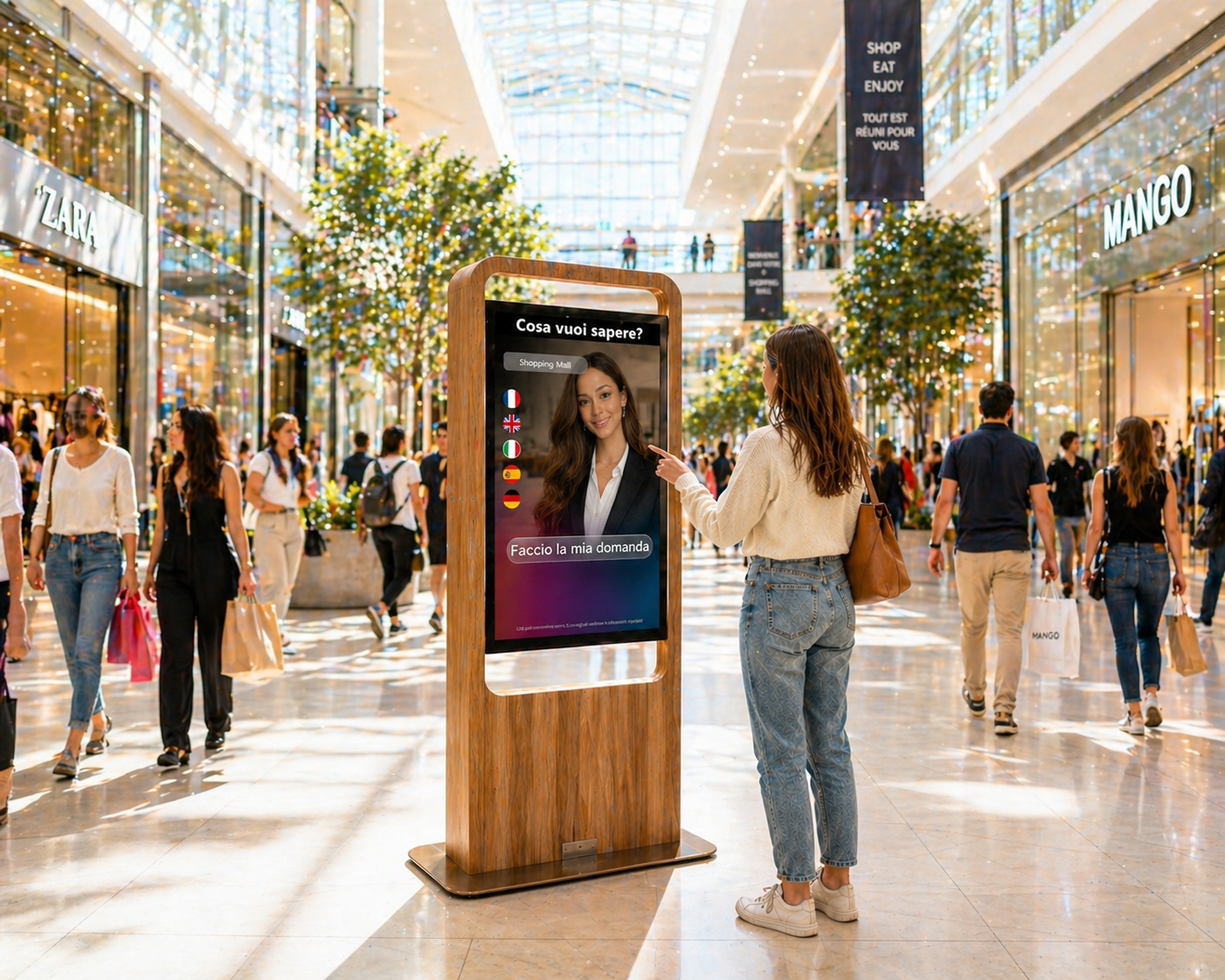
An AI reception avatar is not intended to handle every possible request. It becomes genuinely useful when it covers a clearly defined set of recurring questions, helps people find their way and directs special situations to the right member of staff. For decision-makers, the priority is therefore not to accumulate capabilities, but to select services that match the venue and its visitors.
A clear boundary also makes answers more consistent and keeps decisions, checks and sensitive conversations in human hands. The following method helps allocate roles between a conversational avatar, digital displays, permanent signage and reception teams.
Start with simple, frequent and predictable requests
The first scope to consider includes questions with a stable, approved answer that applies to most visitors. In a corporate environment, this may cover opening hours, the location of a department, directions to a meeting room or initial arrival instructions. In a retail store, customers may be looking for a department, product, service or the reception desk.
These requests are a good starting point because they can be identified through frontline experience. Reception, security, sales and switchboard teams usually know which questions come up every day. A short workshop with these employees can produce a realistic list written in the language visitors actually use, rather than in internal organisational terminology.
Four types of request suited to a reception avatar
- Welcome: introduce the venue, explain its purpose, present the available services and provide useful first steps.
- Inform: answer from business content, documents and information the organisation has chosen to make available.
- Guide: help a visitor find a space, department, product or appropriate contact based on the site’s organisation.
- Prepare the next step: explain where to go or whom to approach when a request falls outside the defined scope.
SANIA brings these reception, information and wayfinding functions together through a conversational AI avatar and a professional display. Visitors speak naturally, while answers are based on the content and services selected by the organisation. Its scope should therefore reflect the real site, its terminology and the visitor journeys that are actually available.
Identify what must remain with human teams
A common request is not automatically suitable for an avatar. A human handover is needed whenever the answer involves interpreting a personal situation, checking an authorisation, making a decision or dealing with a sensitive case. The same caution applies when information is not sufficiently reliable, current or approved for direct communication.
Document these limits in a simple matrix. For every question, specify who approves the answer, how often it may change, whether it depends on the visitor’s profile and which team takes over. This prevents the avatar from becoming a universal help desk and makes its role understandable to visitors and employees alike.
Examples of situations to hand over
- A request requiring access to personal information or verification of the visitor’s identity.
- A complaint, disagreement or situation in which human listening and judgement are essential.
- A question whose answer depends on permission, unconfirmed availability or an internal decision.
- An emergency or unexpected event that must be handled according to the venue’s procedures.
Use the right channel for each type of information
Not every message needs a conversation. Permanent directions can remain on signage. A general announcement can be delivered through digital signage. A spontaneous question requiring a contextual answer from the approved content is better suited to an avatar. A complex situation should go to a person. Good reception depends on this combination, rather than on systematically replacing one channel with another.
Physical placement also matters. The avatar should be visible when visitors begin looking for information, without obstructing movement or hiding signs. Size, orientation, brightness and operating patterns are among the criteria for selecting professional displays. The sound environment and the practical ability to speak naturally should also be assessed on site before the installation is finalised.
Test the scope with real-world scenarios
Before a wider rollout, create a representative set of scenarios: a visitor looking for a meeting room, someone asking about opening hours, a customer searching for a service and a request requiring handover. Test several phrasings, including short or imprecise sentences and everyday vocabulary. The aim is to check not only the answer, but also whether the next step is clear.
Teams who know the venue should participate in testing. They can identify ambiguous directions, department names that mean little to the public or routes that are difficult to follow. Once the avatar is live, appoint an editorial owner and establish an approval process so that changes to hours, services, organisation or access routes are reflected in the relevant content.
A good scope is easy to understand
An effective project can begin with a small number of use cases, provided they address genuine needs and lead to a clear action. Visitors should understand what they can ask, receive usable information and know whom to contact if the conversation is not enough. This framework also gives employees a precise view of their role in the overall reception experience.
Would you like to identify the right requests for your reception area? Contact ALLSAN to define the avatar’s role, the required content, the display and its place in the visitor journey.