
AI reception avatar: how do you design a genuinely useful visitor journey?
An AI avatar delivers value when it addresses specific needs: welcoming, informing, guiding and directing visitors to the right service.
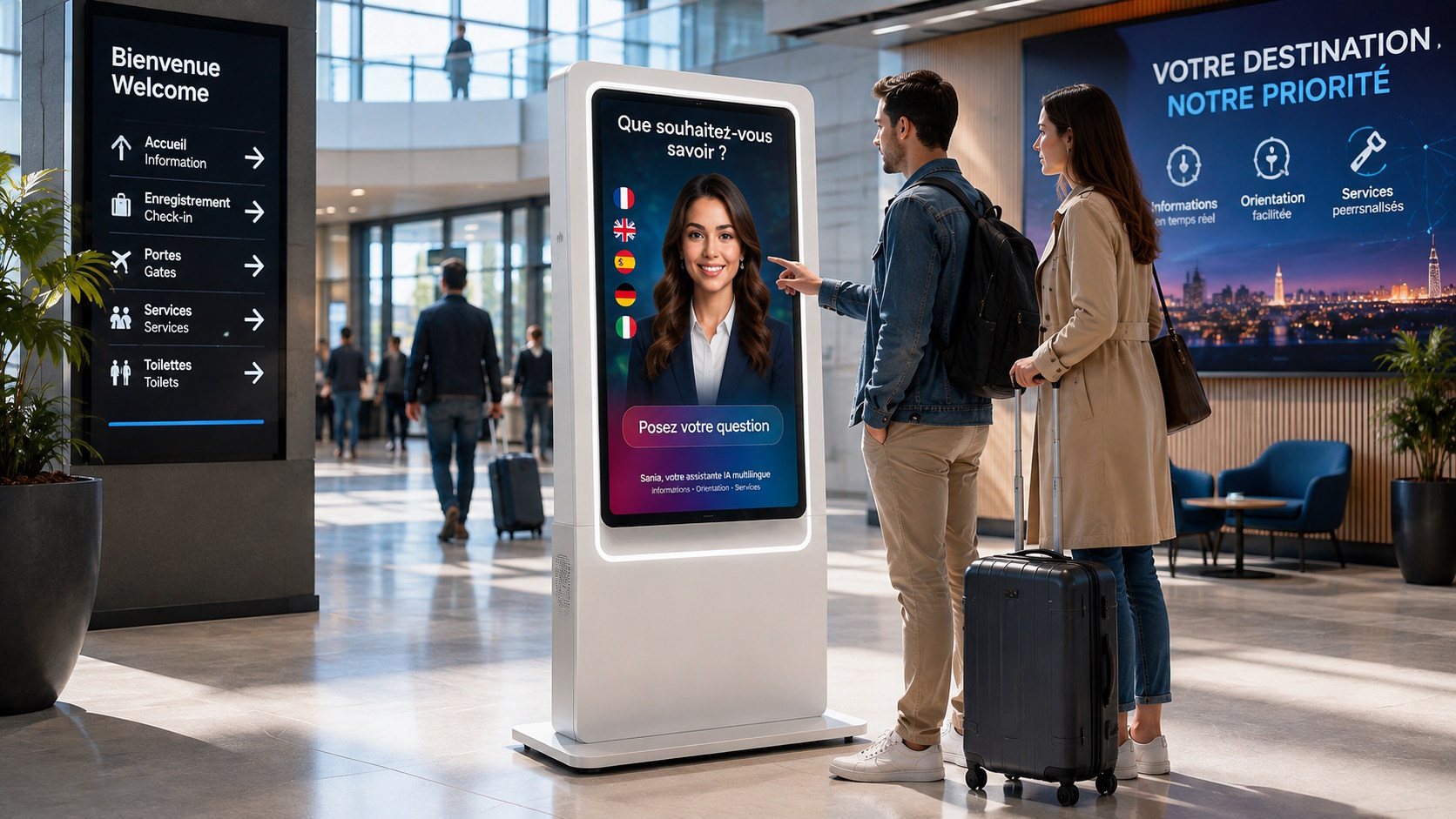
An AI reception avatar should not be installed simply to create an impression of innovation. Its value depends first on the journey built around genuine visitor questions: finding a department, understanding a service, following a procedure or identifying the right person to contact.
An effective project therefore requires a clear scope, approved information, an appropriate location and a defined handover to staff. The goal is not to digitise every interaction. It is to make useful information easier to access.
Start with reception situations, not technology
The first step is to observe what actually happens at the entrance. Which questions are asked every day? Where do visitors hesitate? Which directions are difficult to notice or understand? Which simple, recurring queries regularly take up staff time?
This review provides the basis for an initial service scope. Depending on the venue, an avatar may help to:
- introduce the site and available services;
- show where a department, office or area is located;
- explain the main stages of a visitor process;
- provide opening hours, access conditions or practical information;
- direct the visitor to the appropriate member of staff.
It is usually better to begin with a limited number of clearly identified requests. A focused scope makes content preparation easier and reduces the risk of vague or unsuitable answers.
Build a reliable information foundation
AI-supported reception needs an approved source of information. The content communicated to visitors must be accurate, understandable and validated by the venue’s responsible teams. The experience therefore depends as much on the editorial work completed beforehand as it does on the interface itself.
Each topic should have an internal source, an owner and a review schedule. Opening hours, access arrangements, service names and procedures can change. Without an updating process, even an advanced interface may provide outdated information.
Answers should be written for someone unfamiliar with the organisation. Short sentences, familiar vocabulary and practical directions are preferable. If a subject requires a detailed explanation, the avatar can provide initial information before referring the visitor to the relevant service.
Decide what happens when the avatar should not answer
Defining the limits of the service is just as important as preparing its answers. Some questions may fall outside its scope, require human judgement or relate to an individual situation. The journey should then identify a clear next step, such as the reception desk, a service counter, a member of staff or another channel organised by the venue.
This approach avoids presenting an avatar as a universal replacement for human reception. Instead, it can handle recurring information requests while staff focus on situations requiring listening, a decision or individual attention.
Teams should also understand the purpose of the device. They can then explain how to use it, identify points of confusion and report new questions encountered on site.
Integrate the device into the physical environment
Good content is not enough if the device is difficult to find or use. Its position should reflect visitor flows, visibility, accessibility and the point at which the need for guidance arises.
The display hardware also needs consideration. Size, orientation, brightness and viewing distance should suit the environment. ALLSAN can support this planning by integrating professional digital signage displays.
The avatar must also work with existing signage. If it uses a different name for an area from the one shown on physical signs, it may create further confusion. Signs, digital content and internal terminology should therefore use consistent references.
What role can SANIA play?
SANIA, ALLSAN’s AI reception avatar, is designed to welcome, inform, guide and assist visitors in physical spaces. It combines artificial intelligence, digital signage, natural interaction and customisation.
It may be considered for shops, hotels, town halls, museums, shopping centres and tourist offices. However, each project needs to reflect its environment. Wayfinding in a public administration building is not structured in the same way as a service request in a retail store.
In retail, SANIA can form part of a broader digital signage solution for stores. Within corporate premises, its role may focus on welcoming visitors and providing access to practical information. The content, language and operational handover must be adapted accordingly.
Run a pilot and plan ongoing ownership
Before a wider deployment, a pilot phase allows the visitor journey to be assessed under real operating conditions. The review can focus on straightforward points: whether the invitation to interact is understood, whether answers are relevant, whether directions are easy to follow and which questions remain unresolved.
The project also needs an operational owner. Responsibilities may include collecting new questions, checking information and coordinating with reception, communications and site management teams.
- List the most frequent visitor questions.
- Select the first use cases.
- Prepare and approve the information.
- Define the handover to a person.
- Choose the location of the device.
- Test, observe and update the journey.
This progressive approach allows the service to develop from observed use rather than attempting to cover every possible situation from day one.
Frequently asked questions
Does an AI avatar replace reception staff?
Not necessarily. It can provide a first level of information and guidance, while staff handle individual requests and situations requiring a decision.
What content should be prepared?
Start with recurring practical information: services, locations, access, opening hours and key procedures. Each item should have an identified source and someone responsible for keeping it current.
Where should a reception avatar be installed?
At the point where information is needed, such as the entrance, reception area or a junction in the visitor route. Visibility, visitor flows and the physical environment should guide the decision.
Would you like to define relevant SANIA use cases for your venue? Contact ALLSAN to review your reception journey.