
Interactive in-store games: which format should you choose?
Instant game, recurring campaign or event activation: choose a format that fits your objective, customer journey and operational constraints.
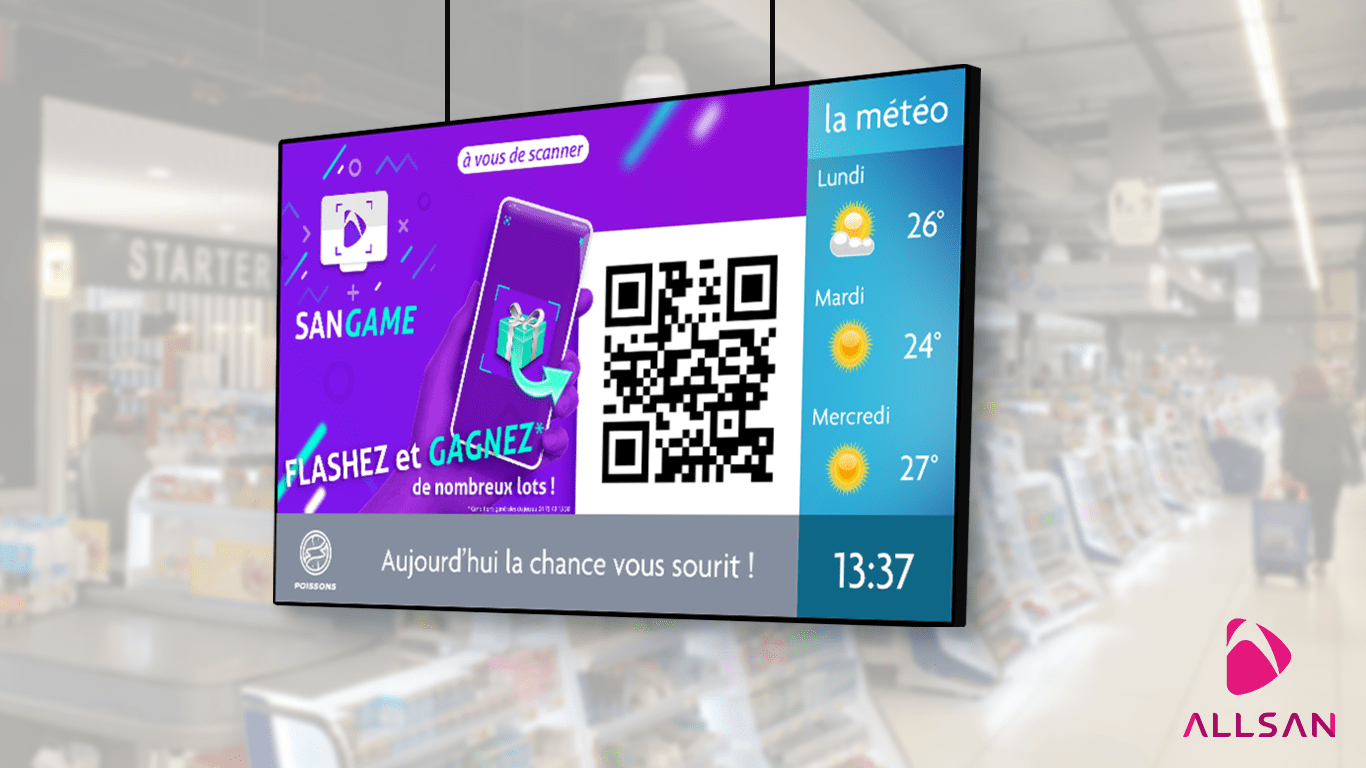
Setting up an interactive game in a store involves more than placing a QR code on a screen. A coherent activation connects the participation mechanism to a clear objective, a suitable location and the store’s everyday operational constraints.
The best format is not necessarily the most spectacular. It is the one visitors understand quickly, can use without disrupting their journey and staff can explain easily. The following method helps decision-makers make the right choices before launch.
Start with the commercial objective
A game can attract attention, support a promotion, accompany an event or create a highlight along the customer journey. Define the priority objective before selecting the mechanism. This decision also determines how the activation fits into digital signage for retail stores without competing with essential information.
- Create an engaging moment around a commercial period or store opening.
- Introduce an offer, product category or service.
- Encourage visitors to look at and use an existing screen.
- Extend a communication campaign through a participatory experience.
Avoid combining several goals in one activation. A simple promise makes the experience easier for the public to understand, simplifies content production and helps store teams communicate it consistently.
Three formats to adapt to the store context
An instant game for quick participation
This format suits areas where visitors have limited time. A visible invitation, a short action and an understandable result reduce hesitation. It may work near a promotional area, provided that it does not obstruct circulation and offers enough distance to read the screen and scan the QR code.
A recurring campaign to establish a regular appointment
An activation running for several days or across multiple stores requires more coordination. Dates, rules, content and any prizes must remain consistent. Responsibilities should be divided clearly between head office, individual stores and any service providers to avoid improvised changes during the campaign.
An event activation to create a highlight
At an opening, internal event or themed day, the screen can become the visible focal point of the activation. A member of staff can introduce the concept, guide participants and resolve misunderstandings. This format requires planning for peak periods and any space needed for waiting visitors.
Build a six-step participation journey
- Attract attention with a short message that is legible from the actual approach distance.
- State the expected action clearly, such as scanning the QR code with a smartphone.
- Explain the essential conditions before the visitor begins.
- Limit the number of steps required to reach and play the game.
- Display a result or conclusion that leaves no ambiguity.
- Explain the next step, including the prize collection process when a prize is offered.
SanGame enables businesses to organise interactive games on digital signage screens. Participants enter the experience through a QR code and use their smartphone, while the screen can present the game or its result. This connection between screen and phone turns a conventional display into a participatory touchpoint.
Give the screen a specific role
Select the location according to the screen’s purpose. At the entrance, it can announce the campaign. In an aisle, it can connect the game with a product category. In a waiting area, it can offer a short interaction. The choice of professional displays should reflect orientation, brightness, viewing distance, operating rhythm and available space.
The content should make sense without a spoken explanation. A clear visual hierarchy, limited text, a sufficiently visible QR code and an identity consistent with the campaign are essential. Digital signage content creation should cover waiting screens, instructions, results and the end of the campaign, not only the main promotional visual.
Prepare operations before launch
- Appoint an activation manager and an incident contact.
- Confirm dates, display times and the removal of content at the end.
- Give staff a short explanation of the game and answers to common questions.
- Test the journey on different smartphones under real store conditions.
- Plan an alternative if the QR code is temporarily inaccessible or the screen shows the wrong content.
Participation rules, prize management and any data collection should be reviewed with the appropriate specialists before publication. The message on screen should not replace required legal information, but it should tell participants where they can read it before committing.
Measure more than the number of scans
Scan volumes may indicate usage, but they are not enough to assess the campaign. Select indicators according to the original objective and the data genuinely available. It is also useful to observe whether visitors understand the invitation, frequently ask staff for help or encounter difficulties because of the location.
- Visibility of the call to participate from the main traffic routes.
- Number of starts and, when available, completed participations.
- Questions, errors or abandonment observed during the journey.
- Time staff spend explaining or administering the activation.
Test before rolling out to multiple stores
A test in a representative location helps verify legibility, journey fluidity and the operational workload. Record the lessons in a deployment kit covering approved content, schedule, installation rules, staff guidance and the end-of-campaign process. This supports a consistent rollout while allowing genuinely necessary local adaptations.
Make the game a useful part of the customer journey
An effective interactive game combines a clear objective, short participation and realistic organisation. ALLSAN can help integrate SanGame into your digital signage journey and prepare an activation suited to your store. To define the format, location and content, discuss your project with our team.