
How do you measure the effectiveness of internal communication screens?
A practical method for assessing message reach, understanding and usefulness without relying solely on the number of screens installed.
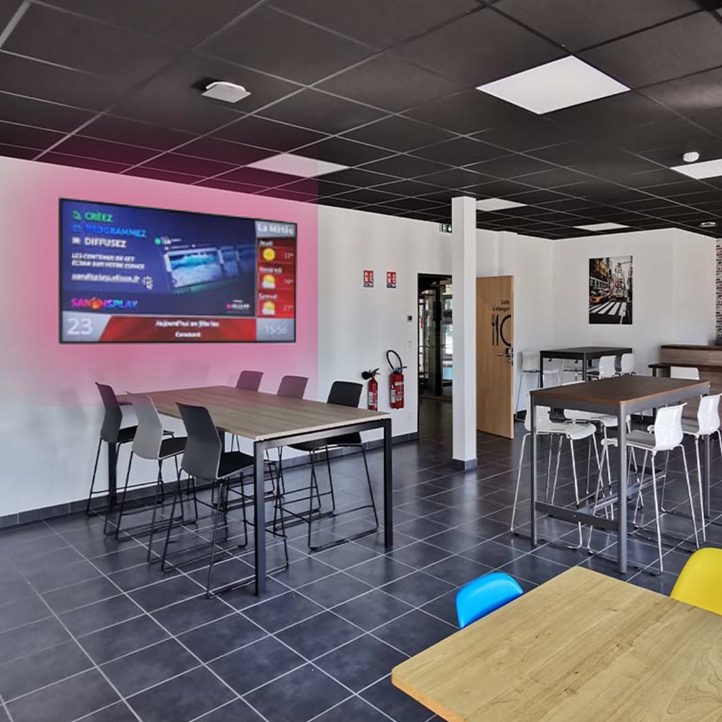
Installing screens across a workplace does not guarantee that information will be seen, understood or remembered. To assess an internal communication system, organisations need to look beyond technical indicators and connect every message to a clear objective: sharing information, publicising a deadline, reinforcing an instruction or making an internal service easier to access.
A useful method examines the entire chain, from confirmed delivery to the expected response. This makes it possible to improve screen locations, schedules, formats and content hierarchy progressively, rather than searching for one metric that supposedly explains everything.
Start by defining what the message should achieve
Effectiveness can only be assessed against an intention. A general company update, a safety alert and an invitation to register for an event do not require the same level of attention or response. Before publication, the communication team should therefore define an observable outcome and an appropriate assessment period.
- For general information, employees should be able to identify the topic and its main deadline.
- For an instruction, the message should be understood quickly and point towards the expected behaviour.
- For an internal service, the screen should raise awareness and explain clearly how to access it.
- For an event, measurement may cover awareness of the date, visits to a dedicated page or registrations.
Measure effectiveness at three levels
1. Actual message availability
The first level is operational. Was the content shown on the correct screens, at the right times and for long enough? Teams should check scheduling, playlist consistency and the condition of the screen network. A relevant message cannot perform well if it appears in a low-traffic area, at an unsuitable time or inside an excessively long loop.
This review also requires an understanding of how each space is used. A reception screen does not reach the same audience as a display near a break area, workshop or meeting room. A corporate digital signage strategy should therefore associate each location with a specific audience and viewing situation.
2. Attention and understanding
Confirmed delivery does not prove that anyone noticed the message. Occasional on-site observations can reveal an obstructed screen, overly dense information or insufficient display time. A very short internal survey can then assess whether employees remember the topic and understand the requested action.
Questions should remain simple: did you see this information, what was it about, and do you know where to find further details? It is generally more useful to ask a small sample at different times than to run a lengthy survey after every campaign. The purpose is to identify friction, not to monitor individual employees.
3. The resulting action or usefulness
When a message calls for action, the indicator should be selected before publication. It could be visits to an internal page, enquiries to the relevant department, registrations or compliance with a procedure. However, any change should not automatically be attributed to the screens: email, meetings or manager-led communication may also have influenced the result.
Set up a simple assessment protocol
- Select one priority message and describe the audience, location, period and expected action precisely.
- Record a baseline where possible, such as current awareness, the usual volume of enquiries or typical participation.
- Schedule the campaign with a realistic reading time and repetition suited to traffic through the area.
- Confirm delivery, then collect brief feedback from people who genuinely belong to the intended audience.
- Compare the results, document the lessons and change only a limited number of variables in the next test.
This process can begin with a pilot campaign before being extended. When comparing two versions of a message, keep the location, period and frequency as similar as possible. If the design, schedule and location all change at once, it becomes difficult to determine what actually improved the outcome.
Build a dashboard people can actually use
A useful dashboard should not collect every available data point. It can combine a small set of complementary indicators reviewed at a pace that matches the campaigns. Operational data helps secure delivery, while qualitative feedback improves writing and design.
- Delivery: screens involved, campaign period, schedules, presence in the playlist and any recorded incidents.
- Potential exposure: normal traffic through the area and the fit between the location and intended audience.
- Understanding: recognition of the topic, recall of the deadline and ability to explain the requested action.
- Business outcome: a visit, enquiry, registration or another action directly related to the original objective.
- Editorial quality: readability, length, pace, visual contrast and clarity of the message priority.
Use the results to improve content
Low recall does not necessarily mean the screen is ineffective. The message may be too long, lack hierarchy, appear too briefly or become lost in the playlist. Teams should distinguish between content, scheduling and location issues before deciding to add more hardware.
Digital signage content creation must account for reading on the move: one principal idea, concise wording and an immediately identifiable next step. Complex information can be divided across several screens or direct employees to an internal channel containing the full details.
What is the role of digital signage software?
Software helps organise the system, but it does not replace objective setting. SanDisplay, developed by ALLSAN, can be used to create, schedule, distribute and supervise content remotely across a screen network. These capabilities support the operational side of a campaign and allow schedules to be adjusted when delivery conditions change.
Frequently asked questions
Should every piece of content be measured?
No. Assessment is most valuable for priority campaigns, new installations and messages that request an action. Routine communications can be reviewed through a periodic editorial assessment.
Is a QR code enough to measure effectiveness?
The number of scans only describes one type of interaction. It does not count everyone who saw or understood the message. QR code data should therefore be combined with delivery information and, where useful, qualitative feedback.
How often should indicators be reviewed?
Technical checks can be regular, while editorial analysis can follow the campaign calendar. A quarterly or twice-yearly review may provide structure, but the appropriate frequency depends on content volume, the number of sites and internal priorities.
Turn measurement into an improvement tool
Measuring screen effectiveness is not about producing more statistics. It means checking that the right message is available in the right place, understood and genuinely useful to employees. To structure your objectives, locations and delivery method, you can discuss your project with ALLSAN.