
Retail media in supermarkets: how should screens be shared between store communications and advertising?
A screen network can support store communications and carry advertising campaigns. Learn how to define roles, locations and broadcasting rules.
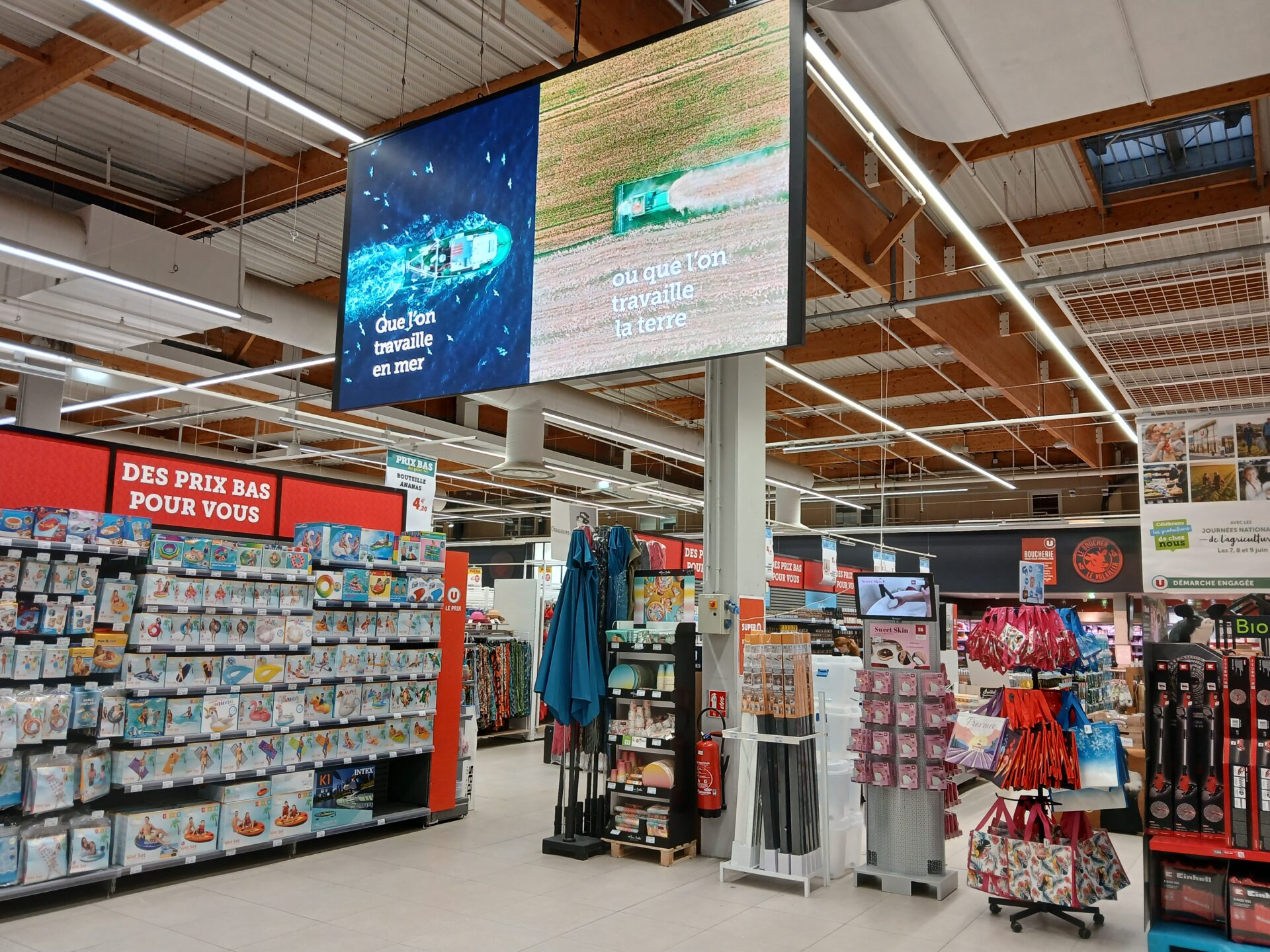
Installing screens in a supermarket is not enough to create a retail media strategy. The real challenge is deciding who communicates, on which screen, at what time and for what purpose. Practical information, retailer highlights, in-aisle messages and advertising campaigns need to form a clear journey rather than a succession of competing prompts.
The complementary expertise of ALLSAN and CTM Pub TV addresses this organisational issue. ALLSAN manages the digital signage technology, while CTM Pub TV operates a local advertising sales activity across its network of screens in partner supermarkets. For decision-makers, the goal is to combine these two areas without losing control of the store’s own communications.
Start by separating three types of content
Before allocating airtime, messages should be classified by function. This prevents service information, a store promotion and an advertiser campaign from being managed in exactly the same way. It also makes decisions easier when several teams want to use the same screen.
- Service content guides or informs visitors through opening times, directions, store news or useful instructions.
- Store commercial content promotes an offer, department, area of expertise, event or retailer service.
- Advertising campaigns are sold and broadcast within an agreed framework on the relevant screens in the partner network.
These categories can coexist, but they are not interchangeable. Urgent operational information, for example, must retain an identifiable place. An advertising campaign needs a suitable context and frequency so that it remains visible without adversely affecting the customer experience.
Give every area in the customer journey a clear role
Effective allocation is not based solely on a broadcasting percentage. It starts with the purpose of each location. At the entrance, a screen can introduce the store environment and present priority information. In promotional areas, messages can support key commercial periods. In an aisle, proximity to products makes context essential. At the checkout, waiting time creates a different viewing situation.
Screen size, orientation, ambient brightness and viewing distance also influence content design. The selection of professional displays should therefore take place alongside the editorial planning, not after the broadcasting plan has been completed.
Create a shared broadcasting policy
A broadcasting policy turns intentions into usable rules. It specifies authorised content categories, relevant areas, approval owners, broadcast periods and the way a priority message is handled. It can also define readability principles such as a duration suited to the location, limited text, sufficient contrast and a recognisable visual identity.
- Map every screen and record its location, format and main audience.
- Appoint the editorial owner for each area and identify who may approve content.
- Define slots for store communications, priority information and advertising campaigns.
- Establish a simple procedure to correct, suspend or replace media that is no longer appropriate.
This organisation protects network consistency when several stakeholders are involved. It also tells local teams what they can modify without disrupting planned campaigns or the retailer’s wider communications.
Connect advertising sales with reliable technical operations
Selling advertising space and operating it technically are complementary responsibilities. The first covers relationships with advertisers and the presence of their campaigns on the relevant network. The second must support the creation, scheduling, broadcasting and supervision of media across the screen estate.
Within the ALLSAN ecosystem, SanDisplay is the software developed in-house to manage content remotely. It provides the control layer required for digital signage. CTM Pub TV, for its part, sells and broadcasts advertising campaigns across its network of screens in partner supermarkets. A clear division of roles helps the store find the right contact depending on whether a request concerns technology, store content or an advertising operation.
Use indicators suited to each objective
Not all content should be assessed using the same indicator. For operations, it is useful to monitor screen availability, schedule compliance and incidents requiring attention. For store communications, the team can check that messages are current, displayed in the correct area and aligned with the commercial calendar. For advertising, monitoring should verify the correct execution of the agreed broadcasting plan.
These checks do not prove an impact on sales by themselves. They first establish that the system is working as planned. Any commercial performance analysis should then be compared with available data, a relevant reference period and the store’s actual circumstances.
Mistakes that weaken a retail media project
- Installing screens without assigning a specific purpose to each location.
- Adding so many messages that the playlist becomes too long or difficult to understand.
- Allowing several teams to change schedules without a shared approval process.
- Designing creative assets without considering viewing distance and exposure time.
- Confusing technical network management with the sale of advertising space.
One shared method, two complementary areas of expertise
A coherent retail media journey depends on a suitable screen architecture, prioritised content and explicit responsibilities. ALLSAN provides digital signage technology, screen integration and support for digitalisation projects. CTM Pub TV contributes its local advertising sales expertise across its partner network. This structure makes it possible to treat advertising as an organised component of the journey rather than a stream added as an afterthought.
Would you like to define the areas, uses and rules for your future network? Contact ALLSAN to scope a project combining store communications, display technology and retail media.